


When you hear "Vietnam," perhaps not many people immediately think of it as a "coffee powerhouse." However, Vietnam actually produces about 1.88 million tons of coffee annually, making it the second-largest coffee-producing country in the world, following Brazil.
It took over 150 years of history and several turning points, from the French colonial era to modern specialty coffee culture, to reach its current position.
Coffee cultivation that began during the French colonial era
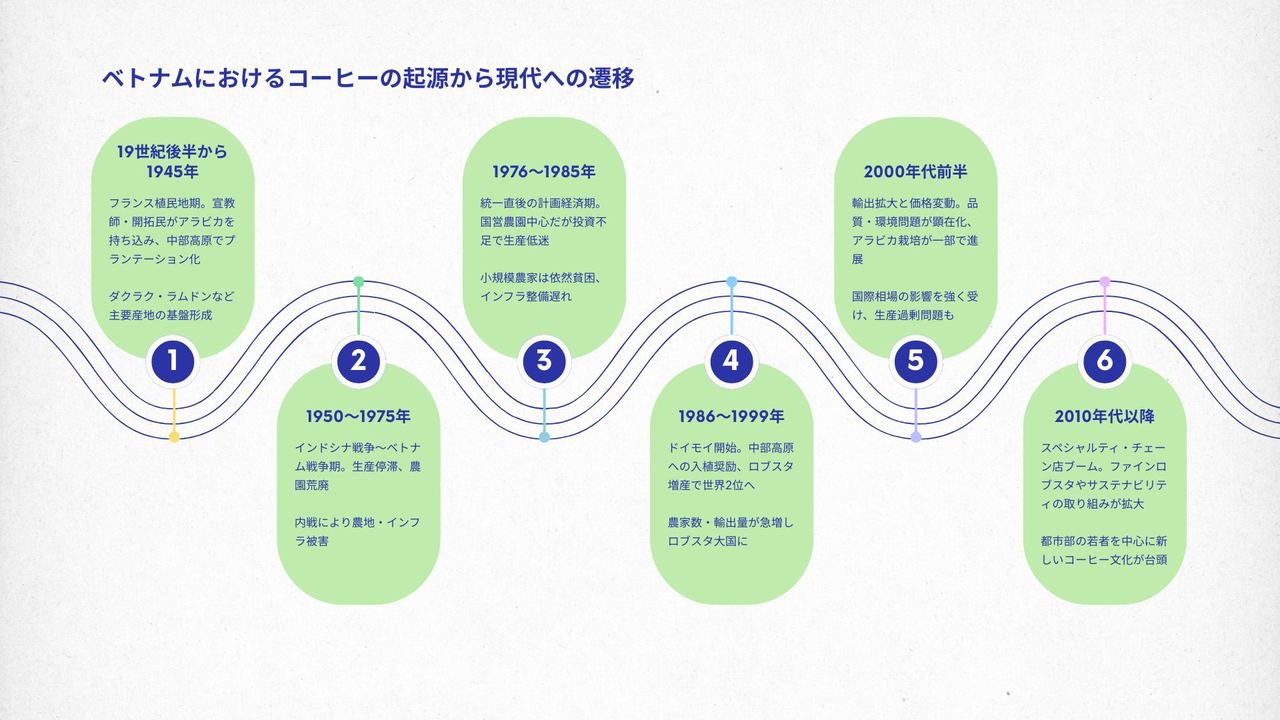
It is said that coffee was introduced to Vietnam during the French colonial period, from the mid to late 19th century. Starting in the 1860s, French missionaries and settlers brought Arabica seedlings to the northern and central highlands, and small-scale cultivation began around churches and monasteries. Later, as the governing structure of French Indochina solidified in the 1880s, coffee was established as a "plantation crop" alongside rubber and tea, and large-scale production was promoted.
France's attention turned to the Central Highlands (Tay Nguyen region), which remains a major production area today. In particular, the highlands of Dak Lak and Lam Dong provinces have optimal elevation, temperature, and soil conditions for coffee cultivation. The coffee planted during this period laid the foundation for what would later be called Vietnam's "coffee belt."
Transition to a mass production system centered on Robusta
In the early colonial period, Arabica species were dominant, but due to diseases and climate, they gradually switched to robusta species, which have higher yields and are more resilient. The expansion of large-scale robusta plantations on the flat lands of the Central Highlands led to a rapid increase in Vietnam's coffee production. Currently, more than 90% of the coffee beans produced in Vietnam are said to be robusta species, and Vietnam accounts for about 40% of the world's robusta supply.
After World War II, production temporarily stalled amidst the Indochina War and the Vietnam War, but the coffee industry experienced rapid growth again with the Doi Moi (Renovation) policy after reunification. From the late 1980s to the 1990s, the government encouraged settlement and coffee cultivation in the Central Highlands, and in just about 20 years, Vietnam emerged as the world's second-largest coffee-producing country.
The background of this rapid growth is a clear direction of "mass production, low prices, and Robusta dominance," with many beans being exported worldwide as raw materials for instant coffee and blends.
Street cafe and condensed milk culture
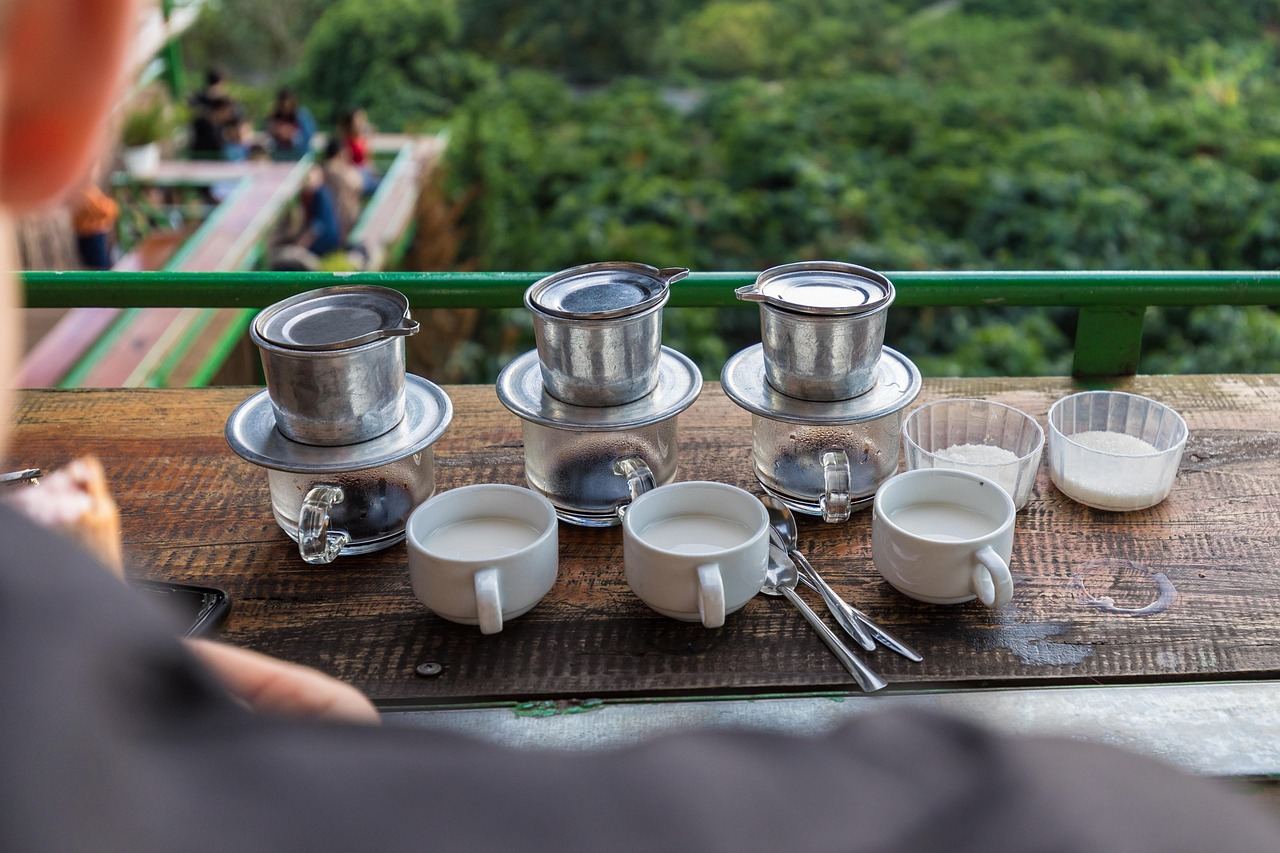
Alongside the expansion of production, Vietnamese coffee culture, as a way of drinking it, also spread. The French-style café culture intertwined with food culture that favored a hot climate and a preference for sugar and condensed milk, leading to the establishment of a style that combined strong Robusta coffee brewed with a stainless steel filter called a "phin" with plenty of condensed milk.
Street-side cafes with small plastic chairs and low tables are everywhere in Hanoi and Ho Chi Minh City, where rich, sweet Vietnamese coffee is a daily staple, from a morning pick-me-up to evening chats. Even today, when you visit Vietnam, you can experience this unique coffee culture, a blend of local-style cafes and stylish, air-conditioned cafe chains.
From Second in the World to an Era of "Quality"
However, while Vietnam has risen to become the world's second-largest coffee producer by volume, it has long been constrained by the image of being a "major supplier primarily of Robusta." In the international market, its trading prices have been lower compared to Arabica from Brazil and Central/South America, and various challenges have been pointed out, including producer income, environmental impact, and quality control systems.
Amidst this, since the 2000s, the shift from "quantity to quality" has been gradually accelerating in Vietnam as well. Arabica cultivation has increased in the higher altitude regions of the Central Highlands, and even among Robusta, which was previously considered a commodity, lots called "Fine Robusta" that approach specialty standards have begun to appear.
At the farms in Lam Dong province where we are visiting, arabica cultivation leveraging altitude and soil conditions, as well as efforts to improve the quality of robusta, are gradually expanding. We strongly feel this "shift towards quality" in Vietnam as a whole at the local level.
At the same time, there is an increasing number of initiatives that balance environmental considerations with producer livelihoods, such as sustainability certifications, traceability, and the creation of carbon-neutral farms.
Younger generations and specialty coffee

In urban areas, coffee chains and specialty coffee shops are rapidly increasing, especially among the younger generation. One survey indicated that the number of coffee chain stores in Vietnam more than doubled from approximately 800 stores in 2019 to over 1,600 stores in 2023, revealing the rapid spread of third-wave cafe culture. The coexistence of traditional Cà phê sữa đá (iced coffee with condensed milk) brewed with a phin filter and new styles like single-origin, light roasts, and hand-drip coffee may be considered characteristic of Vietnam today.
These domestic changes will eventually influence the direction of exports. Vietnamese coffee, which has traditionally focused on instant and blended coffee, is expected to see its presence in the global market grow with coffees that combine stories and quality, such as "lots with visible origins and farms" and "fine robustas that leverage the unique characteristics of robusta."